


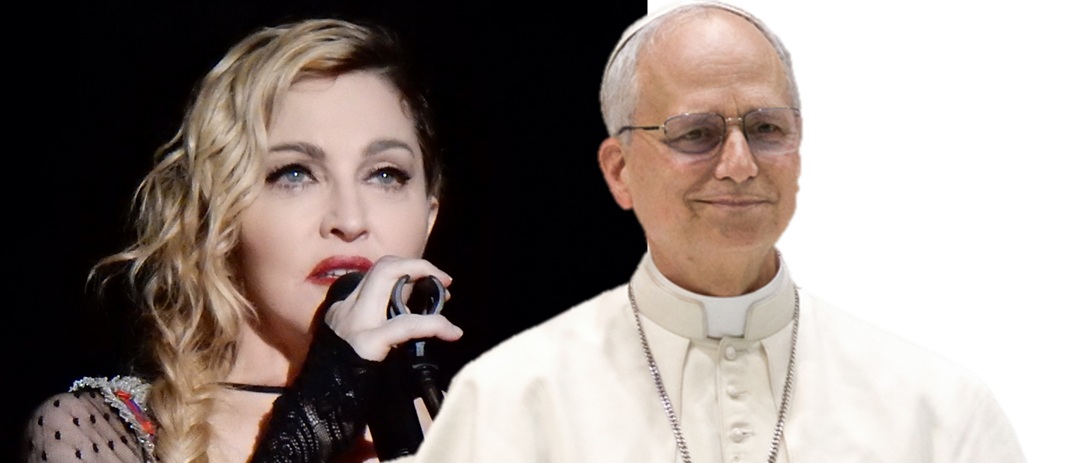
Madonna and the Pope agreeing on something was not on many people’s 2026 bingo card.
For anyone old enough to remember the late 1980s, the pairing feels almost impossible. Madonna built part of her cultural identity by provoking religious authority; the Catholic Church returned the favour with condemnation, criticism and calls for boycotts. Papa Don’t Preach became one of those strange cultural flashpoints that revealed how uncomfortable institutions become when artists challenge accepted norms.
Which makes the current moment oddly poetic.
Four decades later, Madonna and the Vatican seem to be converging on a similar concern—not about music, morality or celebrity culture, but about Artificial Intelligence (AI) and what happens when technology begins to replace judgment rather than support it.
In a recent interview with Vogue Italia, for the July Print Edition, Madonna argued that algorithms and artificial intelligence are “the opposite of taking risks” and therefore the opposite of making art. Her point was not especially technical, nor was it intended to be. It was cultural. Creativity, she suggested, does not emerge from optimisation. It emerges from experimentation, uncertainty, instinct and occasionally getting things wrong.
A month earlier, Pope Leo XIV issued warnings about AI’s rapid advancement, urging stronger oversight and cautioning against allowing technological systems to move beyond meaningful human control.
At first glance these might seem like disconnected observations from two people operating in entirely different worlds. But together they capture something that increasingly feels present across business, government and society: the mood around AI is changing.
Not collapsing, not turning hostile but maturing.
For the last several years, AI has been sold with the certainty normally reserved for industrial revolutions. It would transform productivity. Eliminate administrative burden. Unlock creativity. Accelerate growth. Entire sectors became caught in a race to prove they were moving quickly enough.
There was an assumption baked into much of this thinking that once capability existed, adoption would naturally follow. The assumption was if the technology worked; the organisation would naturally work differently.
Reality is proving less straightforward. What we are beginning to see is not resistance to AI itself but resistance to the idea that AI is automatically the answer.
Some of the clearest examples are emerging not in creative industries but in places where outcomes are measurable.
Take Ford.
Like many companies, Ford embraced AI-enabled systems across parts of its operation, including quality assurance. The logic was familiar: machines can identify patterns faster than people, process more information and operate at scale. In theory, quality should improve while costs fall.
But executives later acknowledged something important. The systems struggled to match the instincts and experience of veteran engineers. The company reportedly rehired hundreds of experienced inspectors and engineers and placed renewed emphasis on using human expertise to improve automated processes, as reported by the BBC.
That admission feels more significant than it might initially appear, because for years the dominant assumption has been that expertise itself could be captured and converted into systems: knowledge in, performance out. What Ford appears to have rediscovered is that expertise is not simply information.
People with decades of practice are doing something more difficult to describe. They recognise context. They spot anomalies. They know when something feels wrong before they can fully explain why.
That kind of judgment turns out to be harder to automate than many expected.
The same tension is beginning to appear in less visible places.
In legal systems, AI-generated submissions are creating new forms of friction. Courts and tribunals are dealing with increasingly long and complex filings. Some legal professionals have faced scrutiny after citing cases that never existed. Processes intended to become faster end up slowing down because someone still needs to validate the output.
That pattern appears repeatedly.
AI removes effort at one stage of a process but can increase effort somewhere else. Writing becomes easier; verification becomes harder. Generating options becomes easier; choosing well becomes harder.
Nowhere does that feel more visible than hiring.
Recruitment has always had flaws, but at least there was an assumption that application materials carried some signal. A strong CV suggested capability. A polished cover letter implied effort. A good interview reflected preparation and communication. Generative AI disrupts all of that.
Candidates can produce tailored applications in minutes. Interview preparation can happen in real time. Entire layers of professional polish are becoming accessible to almost everyone.
On one level, that sounds democratising. On another, it creates a strange new uncertainty. If everyone can present themselves brilliantly, what exactly are employers evaluating?
Some organisations are already responding by redesigning hiring processes entirely — moving toward practical assessments, adaptive interviews and exercises that test reasoning rather than rehearsed answers.
That shift feels symbolic of something bigger.
The organisations adapting best to AI are not necessarily those deploying the most tools. They are the ones redesigning decisions. Because underneath many AI disappointments sits a quieter truth: adoption problems are often organisational problems in disguise.
Most companies already have access to impressive AI capability.
What they struggle with is integrating that capability into real work. Who owns outcomes? Which decisions should remain human? How much oversight is enough? What knowledge becomes more valuable rather than less? These questions are harder than selecting software.
Technology changes quickly – institutions change slowly.
And perhaps that explains why so many AI initiatives still feel stuck in pilot mode. Organisations install tools but leave incentives untouched. Teams experiment but operating models remain unchanged. Adoption gets measured in logins rather than outcomes.
Eventually the excitement fades – not because the technology failed, but because the organisation never actually changed. This may also explain some of the quieter stories emerging from inside technology companies themselves – reports of reassessing usage, questioning cost assumptions and becoming more selective about where AI genuinely creates value.
That is not retreat. It is normalisation.
Every major technology eventually reaches this stage. Electricity stopped being exciting and became infrastructure. The internet stopped being revolutionary and became expected. Cloud stopped being strategy and became plumbing.
AI may be arriving at the same moment. Less magic but more management. And that brings us back to Ms. Ciccone.
Her criticism of AI in art may not be entirely fair. Technology has always expanded creative possibility. Artists adopted synthesisers. Designers adopted digital tools. Filmmakers embraced CGI. Every generation worries new tools will flatten creativity before eventually finding new forms through them.
But her underlying concern still lands. If algorithms optimise for patterns that already exist, who creates the unexpected? Who introduces friction? Who challenges the norm? Who makes decisions that do not maximise engagement, efficiency or probability?
Because progress has rarely come from producing more of what already works. It usually arrives through people willing to depart from the pattern.
Artificial intelligence is remarkably good at scaling what is known.
Human beings remain unusually good at deciding when the known is no longer enough.
That may end up being the real AI reckoning.
Not whether machines can replace us, but whether we remember which parts of being human were valuable in the first place.
————————————————————————————————————-
If you found this article of interest, please don’t forget to sign up for our NEWSLETTER for the latest industry news and insights delivered direct to your mailbox.
Image Credits: Madonna Rebel Heart Tour 2015 – Stockholm (23051472299) by Chris Weger
Pope Leo XIV during a meeting with the media on May 12, 2025 by Edgar Beltrán, The Pillar