

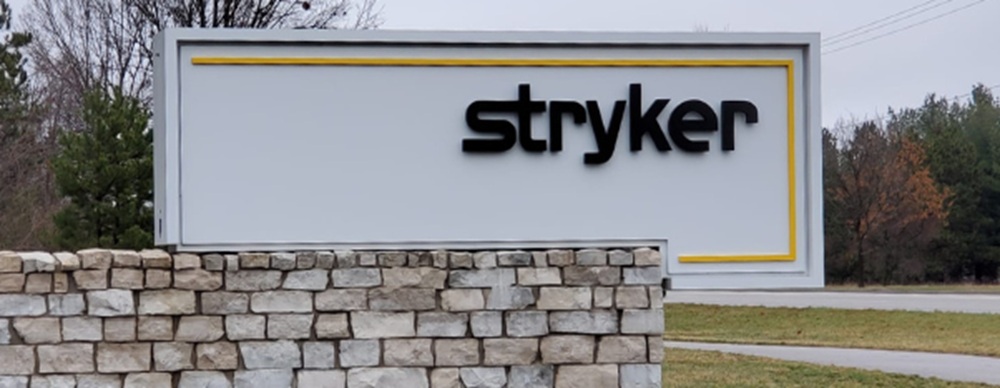
A little over a week since our Cyber Risk and Operational Resilience Amid Middle East Conflict article, highlighting the rising risk of geopolitical cyber disruption, global medical technology company Stryker has become a stark example of that risk with thousands of employees locked out of systems, production halted, and operations disrupted across multiple continents.
Global medical technology company Stryker, a multinational firm with 56,000 employees across 61 countries and $25 billion in annual revenue, experienced a severe, coordinated cyberattack.
Laptops and mobile devices were remotely wiped, manufacturing operations were halted, and thousands of employees worldwide were unable to access corporate systems. Even personal phones enrolled in corporate work profiles were affected.
The market quickly reacted: Stryker’s share price fell more than 3% following reports of the incident. Analysts note that the disruption impacted not only employees but also global supply chains and operational continuity, highlighting the immediate operational and financial risks that can result from a cyberattack, even when the origin of the conflict is thousands of miles away.
How did the Stryker Attack Happen?
Early analysis suggests the attackers did not deploy sophisticated malware, but instead abused legitimate enterprise management tools. Like many global organisations, Stryker allows employees to access corporate email and applications on personal devices through a “work profile” managed by Microsoft Intune. This platform enables IT teams to enforce security policies and remotely wipe devices if they are lost or compromised.
Investigators believe the attackers gained access to high-privilege administrative credentials within the Intune environment, effectively taking control of the same tools used by corporate IT.
Once inside, the attackers triggered a legitimate “remote wipe” command across enrolled devices worldwide, forcing laptops and smartphones to reset to factory settings simultaneously. In other words, rather than breaking the technology itself, the attackers took control of the controls.
This is a crucial point for business leaders: cyber disruption does not always require complex malware or exotic attacks. In modern enterprise environments, the misuse of standard administrative tools can be enough to halt operations globally.
Distance No Longer Protects You
For decades, organisations assessed geopolitical risk largely through the lens of physical exposure. If conflict broke out in a distant region, the assumption was that impact would be localised. That assumption no longer holds.
The Stryker incident shows that a geopolitical dispute thousands of miles away can quickly manifest directly inside a company’s network environment. Corporate IT systems were disrupted, devices wiped across multiple regions, manufacturing paused, and supply chains placed under pressure, all triggered remotely. Ireland, roughly 2,700 miles from Iran, felt the operational consequences just as directly as the U.S. headquarters, with 4,000 people at its Cork base unable to work.
The lesson is stark: in cyberspace, proximity is irrelevant.
Cybersecurity Is a Board Level Risk
For executive leadership teams, the implications are becoming impossible to ignore. Cybersecurity is no longer a technical matter confined to IT; it is a core operational and strategic risk that belongs at board level.
Recent geopolitical tensions have already shown how quickly physical infrastructure can become entangled in conflict. The Stryker incident demonstrates the same reality in cyberspace: international tensions can translate directly into operational disruption, even for organisations far removed from the conflict zone.
What matters is not the specific technology used in the attack, but the speed and scale of disruption. In a globally connected enterprise, a single compromised administrative platform can cascade across thousands of devices, offices, and supply chain dependencies in minutes. The strategic question for executives is no longer who might be targeted next, but how resilient their organisation would be if a similar disruption occurred tomorrow.
The Takeaway: This Is No Longer Hypothetical
The Stryker attack underscores a critical reality: geopolitical instability can now materialise directly inside corporate networks and operational environments. Organisations may have no involvement in a geopolitical conflict, and their headquarters may sit thousands of miles from the epicentre of tension. Yet infrastructure, supply chains, and digital platforms can still become collateral targets.
The digital battlefield has no borders. Distance offers little insulation when global systems, cloud platforms, and device management tools connect organisations across continents. The first sign of disruption may not appear in headlines, it may appear on a login screen, a factory floor, or a production line that suddenly goes silent.
Resilience is no longer about predicting every possible threat. It is about ensuring that when disruption arrives, the organisation can absorb the shock, restore operations, and continue serving customers.
Preparing for Operational Resilience
Incidents like Stryker’s highlight the importance of proactive cyber resilience. Organisations must assume that sophisticated attackers, including state-aligned groups, will eventually test their defences. Preparation, visibility, and response capability are essential.
At vXtream, we help organisations strengthen their ability to detect, withstand, and respond to advanced cyber threats. From proactive threat intelligence and security operations to resilience planning and incident response readiness, our goal is simple: ensure that when disruption strikes, your business can continue to operate. If you’d like to know more, please get in touch.
In an interconnected world, cyber resilience is no longer just about protecting systems – it’s about protecting the organisation itself.
Image of Stryker Corporate HQ © Stryker
A reminder: Don’t forget to SIGN UP to our NEWSLETTER for up to date industry news and insight delivered straight to your mail box fortnightly.

Comments are closed.