

On May 7th 2026, voters across the UK will head to the polls, from council elections in England to parliamentary contests in Scotland and Wales. While debates will span housing, healthcare and economic growth, an unlikely issue is starting to surface at a local level: AI data centres.
What was once a niche infrastructure discussion is fast becoming political, economic and deeply personal.
Communities are asking harder questions. Councils are hesitating. And businesses, particularly those investing heavily in AI, are finding themselves caught between ambition and accountability.
From Enabler to Flashpoint
For governments and industry leaders, the case for AI data centres is straightforward: they are foundational to economic growth, innovation, and global competitiveness. Without them, AI cannot scale.
But on the ground, the narrative looks different.
In the US, a $6 billion AI data centre project in Festus, Missouri triggered such a strong local backlash that voters removed half of the city council shortly after it was approved. Concerns ranged from transparency and land use to environmental impact and strain on local resources.
It’s not just isolated communities pushing back. Across the US, more than $60 billion worth of AI data centre projects have already been delayed or cancelled, often due to energy constraints, planning resistance, or infrastructure bottlenecks.
At the same time, data centres now account for roughly half of all new electricity demand growth in the US, placing them squarely at the centre of debates around energy affordability and grid capacity.
This is not an isolated case, it is a signal. Data centres have moved from invisible infrastructure to highly visible, and sometimes contested, developments.
The same dynamic is now emerging closer to home.
In Edinburgh, proposed AI data centre developments have triggered local opposition centred on energy usage, water consumption and environmental impact. What’s notable is not just the resistance itself, but the nature of it, calls for greater transparency, more rigorous environmental scrutiny, and clearer evidence that “green” claims stand up to reality.
This is becoming a common thread: communities are no longer rejecting data centres outright but they are no longer taking sustainability claims at face value either.
Across both sides of the Atlantic, a pattern is forming: the more critical data centres become, the more contested they are.
The Sustainability Paradox
At the same time, many organisations are doubling down on ESG commitments – net zero targets, sustainability reporting, and environmental pledges.
Yet few are asking a critical question: What is the environmental cost of the digital infrastructure we rely on?
AI workloads are fundamentally different from traditional computing. They require vast amounts of power, advanced cooling systems, and increasingly, dedicated energy generation.
Even at a local level, the implications are becoming tangible. In Edinburgh, proposed facilities have prompted questions about whether their energy consumption could rival that of major urban areas, highlighting the scale of infrastructure now required to support AI.
Globally, electricity demand from data centres is expected to rise sharply in the coming years placing further strain on grids, sustainability targets, and public perception.
Even the most sustainability-focused technology companies are facing difficult compromises, revisiting energy strategies, rethinking carbon commitments, and navigating the reality that AI’s growth is energy intensive by design.
This is not hypocrisy. It’s complexity.
But it does expose a gap between stated values and operational reality—one that boards and executive teams can no longer afford to ignore.
A Question of Alignment
For business leaders, the issue is not whether to use AI or data centres. That decision has largely been made.
The real question is alignment.
- Does your organisation understand the environmental and social footprint of its digital infrastructure?
- Are your sustainability commitments reflected in your technology procurement decisions?
- Do your partners and providers operate to the same standards you publicly endorse?
Too often, the answer is unclear.
Data centres sit several layers removed from the end user. They are procured, abstracted, and optimised for performance and cost, not necessarily for transparency.
But that is changing.
From Cost Centre to Value Signal
In this new landscape, infrastructure choices are becoming signals of organisational values.
Forward-thinking businesses are starting to ask more sophisticated questions of their data centre providers:
- Energy sourcing – Is power derived from renewable or low-carbon sources?
- Cooling methods – Are water-intensive systems being replaced with more sustainable alternatives?
- Efficiency metrics – How is energy usage effectiveness measured and improved?
- Location strategy – Are facilities sited to minimise environmental impact and maximise grid efficiency?
- Community impact – How are local concerns addressed, and what benefits are delivered back to the region?
These are no longer technical questions. They are governance questions.
The Role of Independent Operators
Amid this complexity, independent data centre operators have a critical role to play.
Unlike hyperscale providers, they are often closer to local communities, more flexible in design and deployment, and better positioned to balance performance with sustainability and transparency.
This is not about positioning one model against another. It is about recognising that diversity in the ecosystem, of operators, technologies, and approaches, will be essential to meeting both demand and responsibility.
There are already examples of what this looks like in practice. vXtream for example, is demonstrating that growth and sustainability are not mutually exclusive – powering its facilities with 100% renewable energy whilst materially improving efficiency. In some cases, energy consumption has been reduced by double digits over recent years, despite rising demand, driven by advances in cooling technologies and smarter design.
These are not theoretical improvements – they are commercially viable approaches that challenge the assumption that scale must come at the expense of sustainability.
The future of AI infrastructure will not be defined by scale alone, but by how intelligently that scale is delivered.
A More Mature Conversation
The debate around AI data centres is often framed in extremes: economic necessity versus environmental risk. The reality is more nuanced.
Data centres are essential. They enable innovation, productivity, and growth. But they also consume resources, shape communities, and carry environmental implications that cannot be ignored.
For business leaders, the path forward is not about choosing sides. It is about asking better questions, demanding greater transparency, and ensuring that the infrastructure underpinning AI aligns with the values their organisations claim to uphold.
Because in the age of AI, intelligence is not just about what systems can do.
It’s about whether the infrastructure behind them reflects the values your organisation is prepared to stand behind.
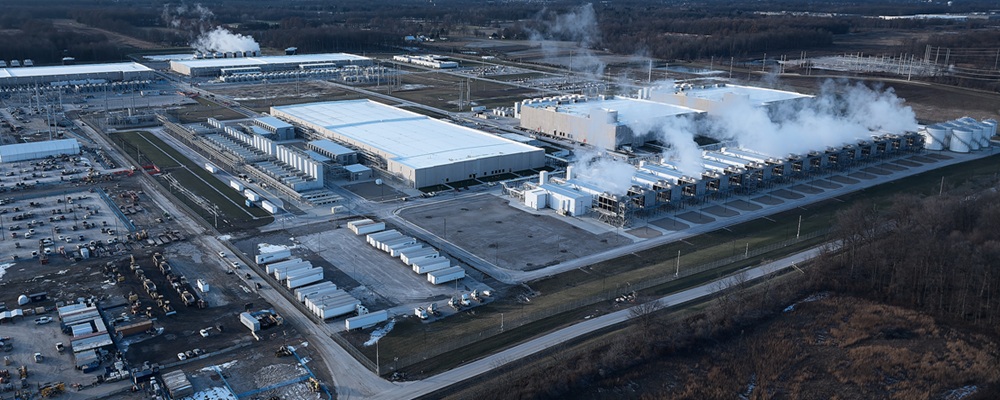
Image © Google – Daytime view of the New Albany data centre campus in Central Ohio showing Buildings 3, 2, and 1
If you found this insight of interest, please don’t forget to sign up for our NEWSLETTER for the latest industry news and insights delivered direct to your mailbox.

Comments are closed.